


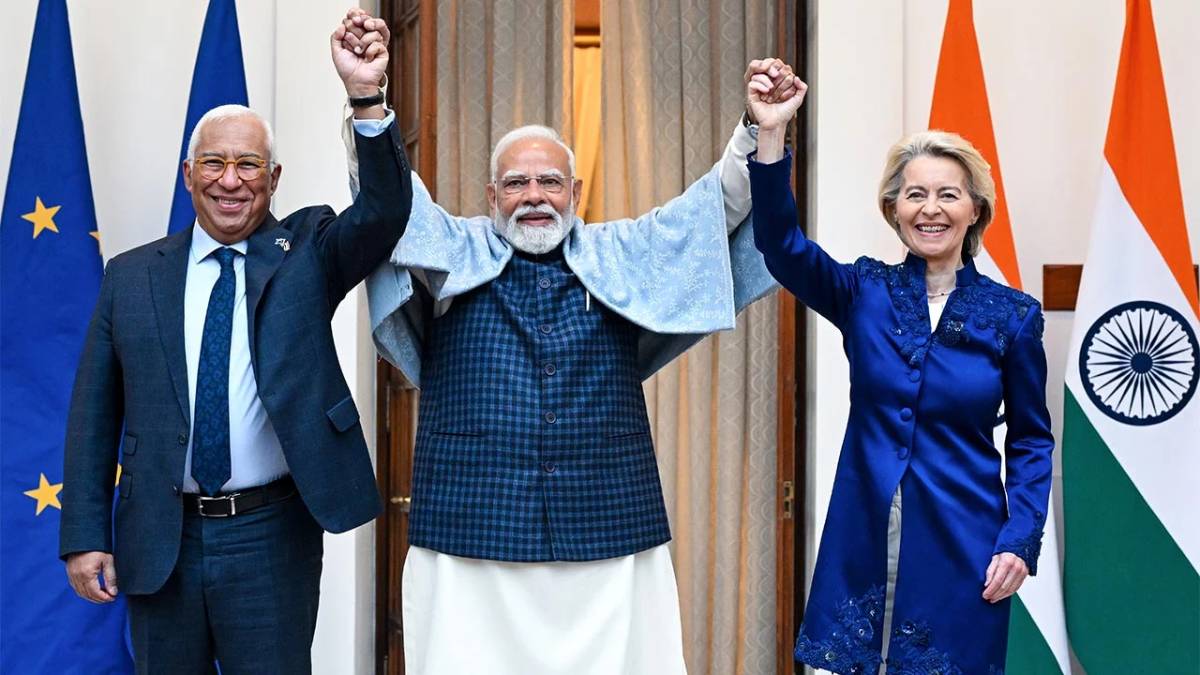

The European Union and India have concluded a free trade agreement that will remove import tariffs on finished jewellery from India into the EU.
Once ratified, the agreement will eliminate duties of up to 4 percent on precious metal jewellery, silver items, and imitation jewellery exported from India. It will also reduce duties on European polished diamonds and gemstones entering the Indian market.
Duty Removal for Indian Jewellery Exports
The agreement includes a provision for duty-free access for finished jewellery products from India to the EU. These goods are currently subject to import duties ranging from 2 percent to 4 percent. According to the Gem & Jewellery Export Promotion Council (GJEPC), this has affected the competitiveness of Indian jewellery exports in the European market.
Finished jewellery will be eligible for zero-duty entry once the agreement is implemented. Loose rough and polished diamonds and gemstones already enter the EU duty-free and are not impacted by the new terms.
Kirit Bhansali, chairman of the GJEPC, said:
“Zero-duty access to the world’s largest consumer market empowers export hubs in Gujarat, Rajasthan, Maharashtra, and West Bengal to ramp up shipments of precious jewellery — plain and studded — silver, and imitation jewellery, capitalizing on India’s renowned design prowess.”
Bhansali also referenced reduced exports to the US, noting a 44 percent drop in 2026, and described the EU agreement as timely in this context.
Reduced Tariffs on EU Diamond Exports to India
In return, India will reduce import duties on polished diamonds and loose gemstones from the EU. These goods, including Belgian polished diamonds, will see tariffs lowered from 5.5 percent to 2.5 percent. This was confirmed by the Antwerp World Diamond Centre (AWDC). The import duty on finished jewellery from the EU to India, currently at 20 percent, is expected to remain largely unchanged or be reduced only slightly, according to GJEPC executive director Sabyasachi Ray.
Implementation and Trade Volumes
The agreement is subject to further steps, including legal revision, translation into all official EU languages, and formal approval by the European Council and European Parliament. India must also complete its own ratification process. A timeline for implementation has not yet been announced.
India’s gem and jewellery exports to the EU were valued at $2.7 billion in 2024, representing approximately 9 percent of global exports in the category. Of this, jewellery shipments totalled $628 million, comprising $573 million in precious jewellery and $55 million in fashion or imitation jewellery. Tariffs have been cited as a limiting factor in the growth of these figures.
Market Scope and Exclusions
The agreement does not extend to the UK or Switzerland, which are not EU member states. Both countries already have bilateral free trade agreements with India that cover various categories of jewellery.
This development follows ongoing tariff-related challenges in the US market, where Indian jewellery exports currently face a 50 percent duty. The EU agreement may offer an alternative outlet for export volumes affected by these conditions.
Industry Outlook
Removing tariffs could increase the availability of Indian-made jewellery in the EU market. Exporters based in India may respond by increasing shipments of jewellery products that align with European market requirements.
The timeline for implementation remains subject to the completion of approval processes in both India and the EU.
